


The True Story of What Happened to The Bloom
THE CHALLENGE OF THE BLOOM
Did you guess The Bloom’s underlying challenge?
You win if you said it’s because it didn’t have a business model.
The webseries was originally launched with a modest Kickstarter which enabled filming for the first summer, while I was still working my day job (communications director for a non-profit) and using vacation time to go film. However, the excitement we were met with told me we were on to something special. Wherever we went, people greeted us and knew what we were doing: “You’re telling our story” is something I heard often. By the end of the summer, it was enough to convince me to give notice at my job to pursue the story full-time.
OPPORTUNITY OF A LIFETIME
By this point, I’d been part of the scene since the late nineties. As soon as I discovered it, I knew I’d found my soul tribe, my people. I became deeply enmeshed: organizing events, playing music, giving talks and becoming a leader in my community. I founded a 5-day New Year gathering on radical and non-commercial principles, which celebrated its 20th-anniversary last year and of which I was a lead organizer for 14 years. I was also tight with several other communities, contributing at festivals and gatherings around the west coast.
All of this effort was done for virtually no money. Our default setting back then was anti-capitalist. Money was polluting, at the root of our corrupt system, and so everything was free, a gift to be shared. All was offered—like everyone else involved—from pure love, rewarded by the fulfillment of the experience and connections. It was a powerful model. In many regards, it still works. (You may be familiar with the ethos 😇) Things now have more of an entrepreneurial pragmatism, which is ultimately more sustainable, but we were very much rooted in this paradigm.
The circles I was part of always understood that what we were doing was revolutionary. The gatherings we co-created and shared were practice for a more empowered, fulfilling and activated reality. But since no money was involved, I always had a day job, while I made time on the side for my true passion. I knew that one day though, an opportunity would arise allowing me to dedicate myself to this culture we had fostered in the gatherings.
That opportunity finally came after first developing a new talk about “transformational festivals” for the festival circuit. This eventually led to an invitation to a long-running retreat, which included New York Times best-selling authors, millionaire philanthropists, and other luminaries, where I received a standing ovation for my talk. That led to an invitation to present at the newly-minted TEDxVancouver event. This was at the height of TED’s prestige, so when my talk was posted, people paid attention and the talk was widely shared. This, of course, led to the creation of The Bloom.
TRUSTING IN THE JOURNEY
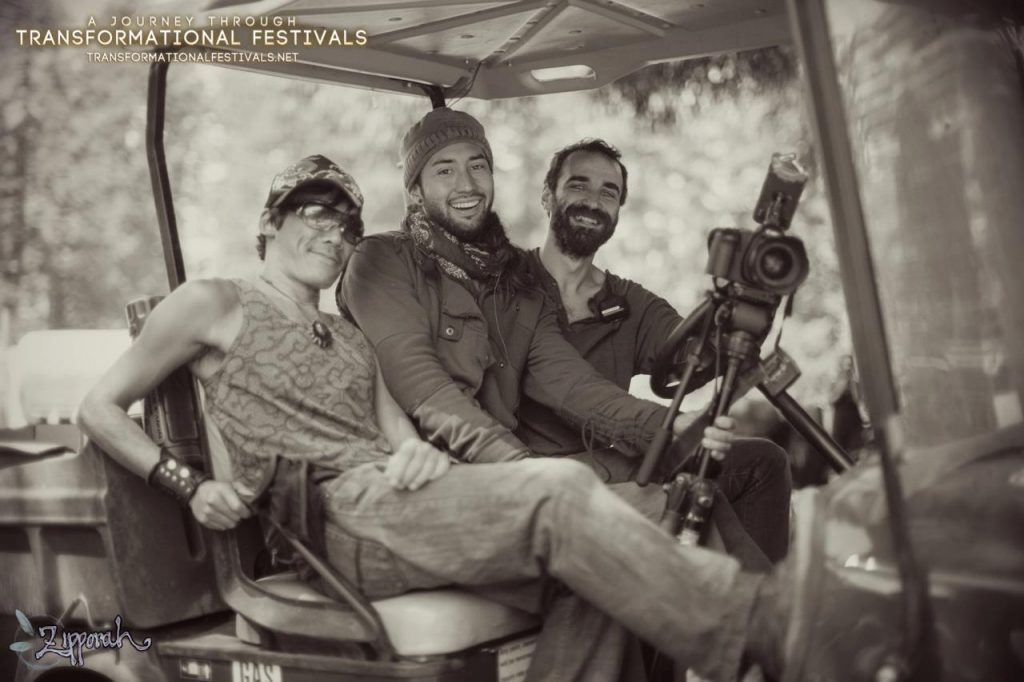
Although we didn’t have financing in place, my original webseries partner Akira and I dove into it. We had the momentum under our wings and the conviction everything would work itself out. We started working on the first “Series Preview” using the footage we had and developed a sponsorship package to secure more funding to keep producing the series. A small team coalesced around us, brought together by the excitement around the project.
In the end, two-dozen businesses and festivals contributed. We posted the episodes online and asked for donations from people inspired to contribute. We also received some modest revenue from soundtrack album sales and community screening fees. The support was gratefully received and wonderful to feel.
However, the series had grown in scope from its original conception. While our Kickstarter had proposed 4 x 15-20 minute episodes, the runtime of the first episode was more than double that and each one got progressively longer as we tackled their themes. By the time the third episode was done, we had released 3 & 1/2 hours of video. This was not vlog-style person-talking-to-a-camera with minimal or no editing, but tightly-edited, fast-paced video with a new clip every few seconds.
IT WASN’T AS EASY AS IT LOOKED
In the end, all the support we received was not nearly enough to sustain even a small team working on the project—even with most of our camera people volunteering their time keeping costs low. Most of the sponsorship contributions were only a few thousand dollars at a time. Money was split up as it came in, but there was a constant stress hovering over of trying to keep the wheels from falling off.
For myself, although I was probably already wearing too many hats for the production (producer-director-host-second editor as well as the de facto primary fundraiser), it was this financial stress that was the hardest part. Especially when it came to taking care of the people who had joined our team. Although The Bloom wouldn’t exist at all without having jumped in feet first despite the lack of experience, it was, without doubt, a trial-by-fire and practical education.
I understand clearly now why productions run in the millions of dollars—film is incredibly labour-intensive and requires a lot of contributors to do well. Still, I have no regrets. It launched an incredible journey and we made something special for that time. It was a necessary part of the evolution of this project, which wouldn’t have happened otherwise.
However, it was only by a heroic effort that we produced as much as we did. The third episode was the length of a feature film and completed in five months without a break from the preceding episodes. This level of effort was unsustainable and came only by over-stretching personal limits, ignoring self-care and living on the verge for too long.
By the time the last episode was released, I was completely burned out and exhausted. With my dad’s death and my border issues now thrown into the mix, it spelled the end for our original funding model and the initial run of The Bloom.
Although battered and weary, I wasn’t ready to give up. I knew we had created something special—that mattered deeply to a lot of people and told a unique story. A story the world needed to hear. For myself, it was the project I had been waiting for that was fully aligned with my sense of dharma and purpose.
It was exactly around this same time of year as now—the dark and rainy season in the pacific northwest—I remember being suddenly back home with the weight of all this on me and asking myself (and the Universe), “How do I do this? How do I keep this important and beautiful thing going?”
READ: THE SEARCH FOR A SOLUTION AND THE OBVIOUS ANSWER ALL ALONG
Hey, Jack here. I’m hooked on your website’s content – it’s informative, engaging, and always up-to-date. Thanks for setting the bar high!
Thank you for sharing this deeply personal journey Jeet-Kei, it sounds like quite the rollercoaster. I am glad you followed your gut to ensure the story stays authentic, and can’t wait to see the outcome.
Thank you for sharing your challenges Jeet-Kei. My father also passed away this past spring to cancer very suddenly and we lost my wife Leah’s mom to cancer last fall after many months of struggle. We did wonder where episode 4 went… we were left wanting so much more and also so very grateful far how much was already given. The Bloom is a gift and your dedication to documenting such a profoundly important historical event as it is unfolding across these many decades is remarkable. We are always behind you and it is known that all is ebb and flow… may your sails be full once again!
Thank you so much, Samuel. I’m very sorry to hear about your & Leah’s losses. It’s a crazy epidemic, inextricably linked to how we live today in contemporary society… Thank you for your kind words and affirmative energy. Very much appreciate feeling your support and incredibly excited to see this fully realized. This is the right time… It’s been quite a few years since that trip to the desert we all took, hey? Still, the journey continues… Big love and the best to you both!